

Ahmed Bahgat

Ahmed Bahgat Consulting is a registered IT consultancy office in the United Arab Emirates MoJ Courts and the Federal Courts for over 8 years of lawsuit cases. with more than 30 years of experience in his field.

رمضان فى عصر التكنولوجيية

Ramadan in the Age of Technology: How Modern Innovations Have Transformed the Experience of the Holy Month

Modern technology and its many applications have undoubtedly influenced every aspect of daily life and human behavior. They have introduced new dimensions and habits. However, maintaining balance is essential when benefiting from modern technological tools such as virtual reality and artificial intelligence, which are now easily accessible through mobile applications and online platforms. One of […]
Ramadan in the Age of Technology: How Modern Innovations Have Transformed the Experience of the Holy Month Read More »

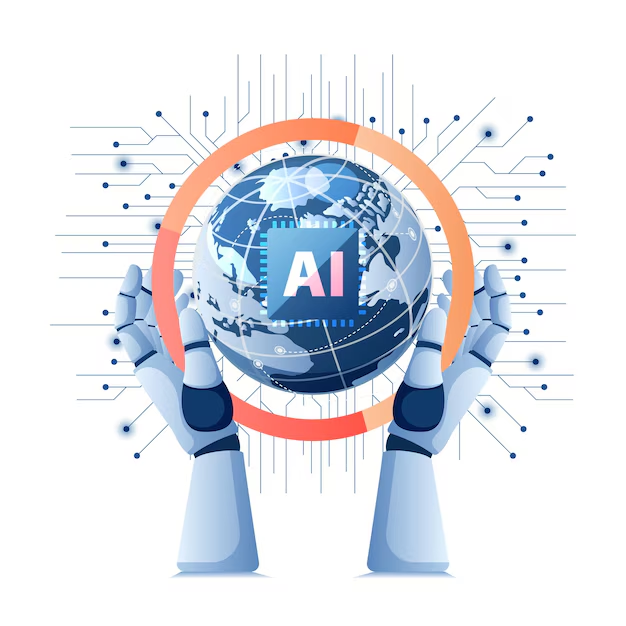
Engineer Ahmed Bahgat Hassan Artificial intelligence is no longer merely a supporting technology or a tool to improve operational performance. Today, it has become one of the most important pillars of modern corporate governance and a key element in supporting transparency, enhancing compliance, and enabling boards of directors to make strategic, data-driven decisions based on knowledge and insights. Drawing on more than thirty years of experience in the field of information technology and advisory work with government and semi-government entities in the United Arab Emirates, I believe that the relationship between artificial intelligence and governance can be understood through two main, interconnected tracks: the use of artificial intelligence in applying governance, and the governance of artificial intelligence itself. These two tracks are complementary and cannot be separated. First: Artificial Intelligence as a Tool for Implementing Governance At its core, governance is based on a set of rules and systems aimed at organizing work within institutions, defining responsibilities, ensuring fairness and transparency, and achieving optimal use of resources. Here, artificial intelligence emerges as a powerful tool capable of transforming these principles from written policies into measurable and monitorable practices. When organizations employ artificial intelligence in governance, they rely on building integrated data management systems, such as data warehouses, which bring together human resources, financial, operational, and supply chain information on a single platform. By analyzing this data, it becomes possible to monitor compliance with internal policies, detect violations and risks at an early stage, and reduce bureaucracy that previously depended on manual and paper-based procedures. Artificial intelligence also provides boards of directors and shareholders with clear, real-time visibility into what is happening within the organization, thereby strengthening accountability and supporting decision-making based on accurate facts rather than personal judgments. Second: Governing Artificial Intelligence — The Most Sensitive Challenge On the other hand, the governance of artificial intelligence raises fundamental questions related to controlling algorithms, data integrity, privacy protection, and intellectual property. Artificial intelligence relies primarily on data, which has become one of the most valuable and sensitive assets of modern organizations. Any weakness in data quality or bias in algorithms can lead to incorrect decisions or unfair outcomes. This makes it essential to establish clear frameworks for regulating data sources, defining access levels, and assigning legal responsibility for the outputs of intelligent systems. Cost and Value: The Decision Equation One of the most frequently asked questions among executive leaders is whether investment in artificial intelligence is economically viable. The answer is not a simple yes or no; rather, it depends on conducting clear use-case studies that define technical requirements, human resources, operational costs, and the expected return. While these solutions require investments in infrastructure, storage, software, and specialized talent, their true value is not measured solely by direct financial returns. Instead, it lies in the transparency, control, and comprehensive visibility they provide over organizational performance—strategic gains that are difficult to quantify in numbers alone. Legislation and the Human Element The success of using artificial intelligence in governance remains closely linked to the existence of clear legislative and regulatory frameworks. This is an area to which the United Arab Emirates pays great attention through the development of laws governing data and modern technologies. At the same time, the human element cannot be replaced; rather, roles evolve to focus more on oversight, analysis, and decision-making. The era of artificial intelligence imposes a shared responsibility on individuals and institutions alike to develop skills and engage in reskilling, and to use these technologies ethically and responsibly, with due respect for privacy and intellectual property. Artificial intelligence is not a substitute for humans, but a strategic partner that reshapes the concept of governance—transforming it from a traditional regulatory framework into an intelligent system capable of prediction, prevention, and decision support. Institutions that recognize this reality early and invest in it thoughtfully will be the most capable of achieving sustainability and success in the near future. Information Technology Expert and Consultant

Artificial Intelligence and Governance: From a Technical Tool to a Pillar of Decision-Making

Engineer Ahmed Bahgat Hassan Artificial intelligence is no longer merely a supporting technology or a tool to improve operational performance. Today, it has become one of the most important pillars of modern corporate governance and a key element in supporting transparency, enhancing compliance, and enabling boards of directors to make strategic, data-driven decisions based on

Artificial Intelligence and Governance: From a Technical Tool to a Pillar of Decision-Making Read More »

The Basic Human Needs in the Age of Technology

In 1954, the American psychologist Abraham Maslow introduced what became known as the “Hierarchy of Needs,” which included: But today, in 2025, we are compelled to re-examine this framework.What are the true essential needs of a human being in our current age? The Digital Shift in Basic Needs From my perspective, the basic needs of

The Basic Human Needs in the Age of Technology Read More »

The Role and Impact of Technology

The Role and Impact of Technology in Our Daily Lives

Today, no one can deny the deep integration of modern technology and itsapplications into nearly every aspect of daily life. Technology has become apowerful social force that significantly shapes human behaviour and interactions atall levels.Modern technologies and their countless applications have undoubtedlyinfluenced every area of life and human behaviour. They’ve introduced new habitsand dimensions to

The Role and Impact of Technology in Our Daily Lives Read More »

The Complex Challenge of Governing AI Relationships Across Borders

Throughout my 25 years in IT and dispute resolution, I’ve witnessed how artificial intelligence has transformed the fabric of our society. What fascinates me most is not just the technological advancement, but the intricate web of relationships it has created between businesses, governments, and individuals. As someone who regularly mediates technology disputes, I’ve seen firsthand

The Complex Challenge of Governing AI Relationships Across Borders Read More »

Empowering Society Through Digital Literacy: The Key to a Connected Future.

In the 21st century, digital literacy is no longer a luxury but a necessity. Astechnology permeates every aspect of life—from communication andeducation to work and entertainment—being digitally literate is crucial fornavigating this evolving landscape. However, while the world becomes moredigitally connected, a gap in digital literacy remains, leading to social andeconomic inequalities. This article explores

Empowering Society Through Digital Literacy: The Key to a Connected Future. Read More »

Press Image